
Borrowing bonded bourbon
Vol #259: January 20th, 2026

Whiskey has been a part of American history since the beginning.
So much so that when George Washington finally retired after eight years in the presidency, one of the first things he did back at Mount Vernon was set up a whiskey distillery. Records suggest he was one of the largest producers of his time.
Abraham Lincoln’s course was reversed - he spent his young adulthood tending frontier bars and running taverns before he got his law degree and moved to Springfield, Illinois. By the time he got into politics the temperance movement was ascendant and this detail on his resume chafed in certain circles.
As the 19th century progressed, the relationship between whiskey producers and the government ebbed and flowed. Taxation was a perennial issue, but distillers also invited compliance that would regulate quality, and prevent imitation. The reason many bourbon bottles to this day are decorated with their founder’s signatures is because forgery was a crime long before any truth in labeling laws existed.
It almost always comes down to the money though. The taxes on alcohol continued to creep up, and one particularly limiting technicality was that producers owed payments as soon as the spirits came off the still. That pinched, because while George Washington might have been able to sell his whiskey white, these days most consumers wanted a little bit of age on it.
The standard for bourbon is four years in charred oak barrels, though it technically only requires two. But a distiller had to float that cash for taxes while his product continued to ripen. Starting with the introduction of the bonding system in 1868, so long as the barrels were under government lock and key, payments could be deferred first by one year, and then later up to three.
This market structure meant both small and large operations were selling their product as soon as the tax bill was due. Fortunately for bourbon drinkers, there’s nothing like a good economic crisis to shake things up.
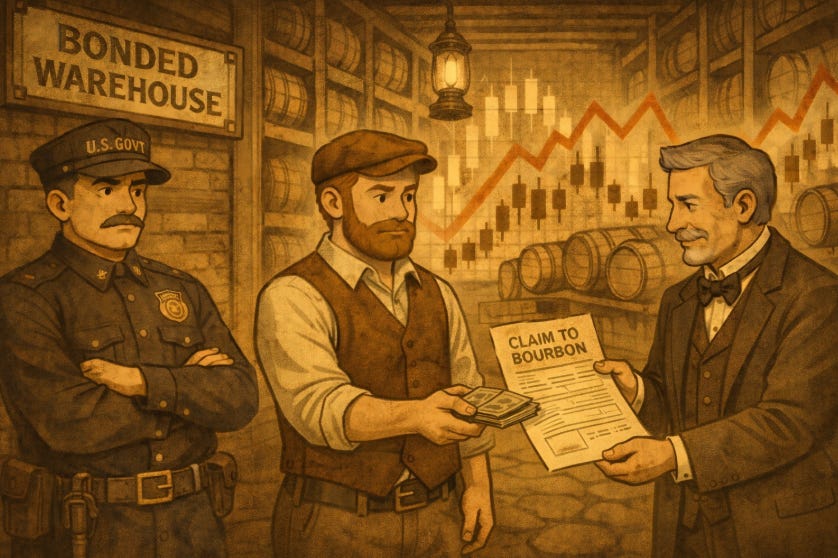
After the depression of 1893, distillers lobbied to increase the bonding period to eight years, but more importantly they developed a system of warehouse receipts that allowed the aging whiskey to be used as collateral. Now not only did the whiskey get to stay tax free longer, there was a tradeable instrument to borrow against.
Just as futures on agricultural products dramatically shifted the way farmers can manage their business, so did collateralized, bonded, bourbon. Financialization loves a good pledged asset.
Whether you’re in DeFi with locked up tokens or a brokerage margin account, borrowing lets you access the value of something without having to turn the asset into something more fungible like cash. The key word here is borrowing.
When you borrow from a trading account, no one asks what you’re going to do with the money. In some cases it’s so easy you might not even realize you’re doing it. Both a good trader and a good investor are asking themselves why.
Distillers are tapping into an advance for cash flow timing reasons. Keeping around a bunch of extra cash to pay forward taxes would be a sub-optimal business strategy. Building more rickhouses to grow the operation should earn a better return than the cost to borrow funds against your stock.
Individuals might have cash flow timing questions too, but more likely borrowing is to either invest or consume. In both cases you end up with leverage.
Leverage for consumption is a dangerous game. By definition, that cash goes away and you’re left with experiences or second hand goods. You’re fighting two forces - a declining balance to withdraw from and a compounding interest rate slowly picking away.
If you want to borrow money against one investment to fund another, this form of leverage can yield some offsetting benefits. Unless you invest with the intent to lose money, the new asset should have gains that more than cover the interest rate you’re paying.
The question of why is unique to every individual. It might be a question of liquidity of the underlying asset, or unsurprisingly it often comes back to taxes. The pain of interest might be less than the capital gains rate.
The principal risk of collateralized borrowing is that the pledged asset goes down in value. Just look at the prices of Pappy van Winkle and you see bourbon has an upside volatility bigger than the S&P 500, but there is always a risk to the downside. Traditionally lenders defend against this with borrowing ratios.
With equities, and equity options, you can defend against this with a lot more nuance. If you’ve decided that pulling cash out of your stocks is a good idea, there are a couple of interesting ways to do it. (Financial advice - double check your premise.)
If you’re borrowing a few percentage points of value, your leverage ratio is very small and might not even be worth hedging. Conceptually this is owning 105 shares for 100 shares of cash, so every move is 5% bigger.
An options collar can neutralize your leverage ratio. Borrowing against stock with this position locks in the value as if you sold it, but you still get the benefits of ownership like dividends and don’t have to pay the taxes. Since most stocks price a positive forward interest rate around the T-bill rate, selling a collar at the current spot price gives you that interest premium up front.
There are a couple of catches. There’s the tax implications of what your options did in the short or long term, and there can be quirks with early assignment if the short call goes too far in the money. Complexity can improve your position here, but there are a lot of moving parts.
Just as you can borrow with your brokerage account, you can also play the other side of the coin and lend. The box spread has gotten famous again recently with its clever use in the BOXX ETF. Here you buy a spread that looks a lot like a zero coupon bond, and collect the full value at maturity. The taxes also typically make it more favorable than government paper.
Hypothecation is what makes the world go round. Options traders are just along for the ride of what is a much bigger and deeper borrowing and lending market. But liquid index options reflect these forces very well, and present some unique opportunities for traders with sizable equity positions.
The catch here is that at some point the bills come due. The arc of lending bends strongly towards repayment. If you’re diligent with the proceeds, this can compound positively. Just don’t get caught up thieving from your own barrels.