
Faster than that
Vol #265: March 19th, 2026

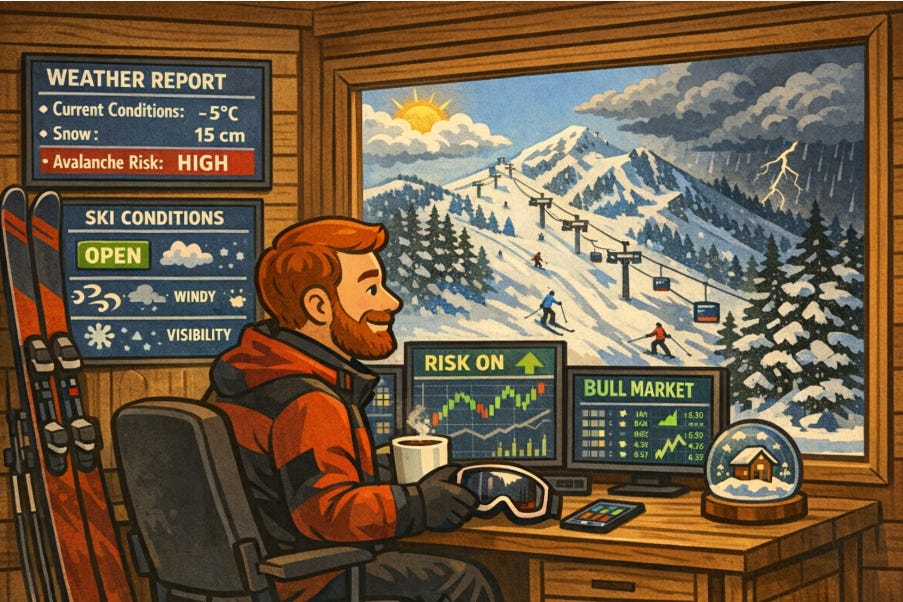
Tomorrow is the first day of spring.
That makes today the last day of winter, though anyone who’s been on a ski mountain knows it’s already spring conditions.
It didn’t matter last weekend though. Mohawk Mountain had almost every trail open, and the pellety slush that passes for packed power was no bother at all. My daughter and I got out there and did run after run, lapping at least a dozen on the bunny slope before I convinced her to take on something bigger.
She loves the chairlift, and was excited that we got to take one that was significantly longer. Deer Run was the trail I first cut my teeth on too, so those tinted goggles were fighting off the sun and holding back big baby seal tears.
Most of the time the runs underneath the chairlift are steeper and more difficult, so you get to watch the better skiers flaunt their prowess. No matter how many times you’ve been up the mountain, this is evergreen entertainment. Appreciate the graceful arcs, and relish the schadenfreude of a spectacular wipeout - so long as no one gets seriously injured.
“Daddy, do you ski faster than that?”
Every parenting bone in my body was fighting the skills I had built over more than thirty years of hitting the slopes. I take my hobby seriously, and while the days of 210cm string bean skis are gone, I’m still surfing on a fat underfoot and planks two inches taller than me.
Knowing that my favorite thing in the world was dropping in and zipping past every skier on the trail collided with the fear of being that parent chasing a runaway train. I hedged. I cut a big S turn across a challenging face. “Sometimes.”
The key to a great day on the slopes is pushing your ability to just within a fraction of where it fails. And if you want to go faster than that, it usually means a few falls. But I’d much rather they come at 15mph on the mogul trail when these old knees can’t Johnny Mosely anymore rather than because you can’t hold an edge at 50 mph.
You can’t have the rush without the speed or technical challenge. Opportunity comes from risk.
But you can’t just dial everything up and hope it works out. Knowing when and where to apply your risk is just as important as knowing what your tolerance, capacity, and aptitude are.
The first step in adding more risk is to start with small doses. Going from zero to one contract is the biggest change a trader or investor will ever experience. It’s going to be different, unusual, and guaranteed to have unexpected outcomes.
A one lot is the most significant trade you can make. It’s live fire that behaves in exactly the same way as a hundred lot, just one percent of the magnitude. If that math isn’t blatantly obvious, you definitely shouldn’t be trading options. But the importance of that cannot be understated.
Even if you have a three comma balance, the first trade is a one lot. Here’s how SkewPreme behaves. Here’s what HedgeRoll has you missing out on. Can you handle the FOMO or surf the kurtosis?
Once you’re comfortable with a one lot, scaling up and down is easy. The question becomes when. It’s obvious you don’t barrel down the congested part of the trail, and there are very few permanent strategies with options. By definition they expire.
One of the most common problems I am presented with is the decision of when to hedge. Risk on is the default for most investors, but we also know that tariffs, COVID, or a war in the middle east happen. When is the best time to dial things back, or put on an offsetting position?
Always on strategies rarely work for hedging. The most naive example is the cost of an ATM put - you give up the better part of the equity risk premium to get only upside. You’re better off with a bond. Fancier hedges like VIX call laddering run into similar problems - you end up churning premiums that don’t monetize when you need them to.
Signals are a critical part of risk taking. You want a signal to get you into a trade, and you want a signal to take risk off. When the VIX goes into backwardation (spot value above the future value) that’s a warning that things are going to be - or already are - choppy. Skew or other volatility indicators can also signal time to hedge. (The VIXMix by Jim Carroll is a fantastic amalgamation of these.) When the beacon flashes red - get out, collar up, or lift some teenies.
So what strike should I buy or sell?
There’s a quantitative solution to this, and then there are feels. As liquid and precise as the strike selection can be in the SPX, for most other stocks you’re gonna have to make a call about which strike and month to buy. So the subjective creeps in, and you just have to trust your gut.
Whether you’re paying to hedge, or selling to collect, a little can go a long way. The costs of hedges rack up if you’re doing it too frequently. They compound if you add in significant tax drag and missed opportunity from market timing.
On the sell side, fat premium is juicy for a reason. Selling too close to the money leaves you with significantly more trade management. Small and nimble is more effective in collecting the relatively modest additional percentage points of risk premium available. Remember that options trading doesn’t make money.
Risk is good. Well applied it becomes a cheap and complimentary element to your portfolio. It just comes down to when and where. Which is probably less often and smaller than you think.
For an options investment strategy that’s fine. Just a little bit faster goes a long way. Relish the opportunities when you do get to take a little more risk.