
Fingers on the scale
Vol # 279: July 9th, 2026

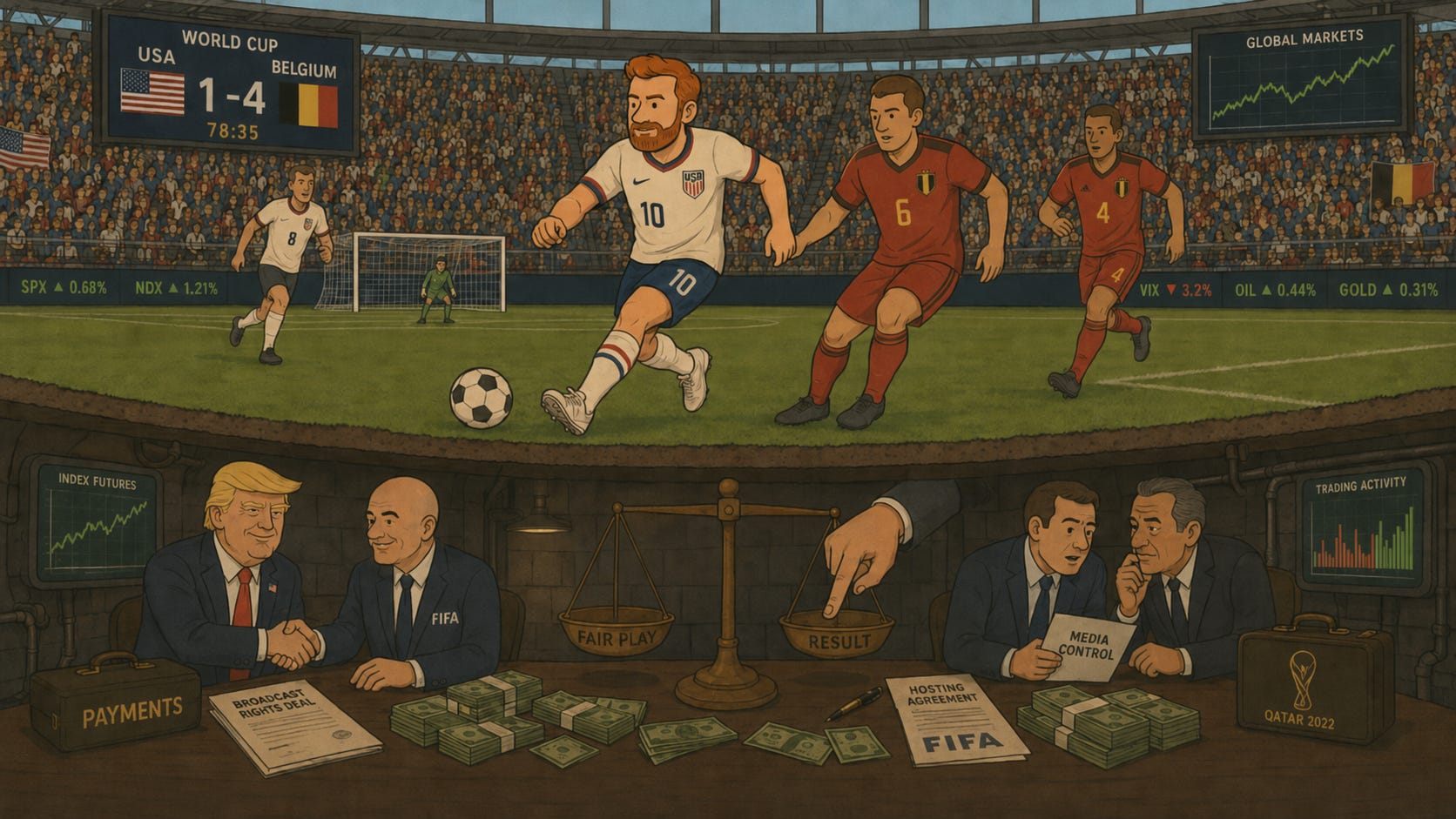
Despite an incredibly disappointing loss earlier this week, America has finally become a soccer nation.
World Cup fever has swept the nation from Seattle to MetLife stadium. Millions of tourists ventured across the Atlantic or Pacific to watch their home country’s team battle for the biggest prize in sports. And Americans are right there with them.
Every restaurant with a television has become a de facto watch party, with new teams like Cape Verde seizing hearts and minds, while the old guard like Argentina continue to show their charm. You might not see soccer for another four years, but everyone is caught up in the here and now.
Whether you’re still learning the intricacies of the offsides rule, or grappling with what video review has done for the beautiful game, football fever is inescapable. Even your average New York Times reader who’s never set foot in a stadium knows what “Ro!” means.
But what has earned the US Men’s National Team its international stripes, is a far darker element. Even worse than flopping, we’ve learned how to put our finger on FIFA’s corruption scale.
Few public organizations have as bad of a reputation as the governing body of international football. Systemic corruption, bribes, and financial self-enrichment are the hallmarks of the most popular sport in the world. Kick backs and vote trading decide who gets into the cup, and apparently now, ex-post, the backrooms determine the validity of penalty calls.
While I was happy to learn that US striker Folarin Balogun’s red card was thrown out, it cast a dark shadow over the game against Belgium. Say what you will about the call, the maneuvering by the US President to cash in his loyalty check with FIFA tarnishes any benefits. Now instead of the USMNT being fired up by an injustice, they were hiding under a shadow, while all the retributive power had been transferred to their opponents.
“Working the ref” is nothing new in either sport or business. Baseball coaches get in the face of an umpire’s bad calls not in hopes of overturning the result, but to galvanize their team. Soccer players defend their actions to let the referee know that they are under scrutiny, and plant a festering, self conscious seed of doubt.
Just the suggestion of unfairness is powerful, and subtly warps the arbitrator’s mind. Referees more than anyone want the game to be considered as fair and well chaperoned. In a firm but reasonable manner, just as important as playing fairly is reminding everyone else you’re doing the same.
One of my most difficult professional responsibilities was a referee like position. At least with trading you can live and die by PnL without hurting anyone else’s feelings. Deciding who got access to trade what products and when, was an absolutely thankless job.
There was one trader who drove me crazy. Anyone around at the time knows who I’m talking about. While he was a solid performer, he wasn’t the best of the best, and knew that. So he worked the ref like it was nobody’s business.
Sometimes it came as a charm offensive - “oh man, it’s going to be really tough allocating the first traders to UBER, how are you going to do that?” Underhanded commiseration that let me know he was watching.
Other times it was more direct - “Why did so and so get allocated Facebook?” Even a profanity laced tirade once or twice.
This trader was even willing to play the long game, and advocate to anyone who would listen that there should be a more automated and predictable internal allocation process, figuring he could game the system in some other way.
And you know what he got out of this? Better allocations than he deserved. Not every time, but consistently enough that it probably made him a little bit of extra money. Even in the most black and white of games, where the only thing that makes cents are dollars, working the ref still provided an advantage.
Every company has their own internal politics, but the market referees were someone to be worked also. To varying degrees every pit has a floor official who is responsible for arbitrating the contentious decisions. Who yelled the price first? Was his foot inside the white circle of the pit allowing him to respond?
The rules are firm in what goes where, but if you’re relying on human judgement, there’s going to be grey. No VAR in the trading pits (thankfully). If you’re friendly enough with the floor official and consistently remind him how quick you are, claims become ideas and then they become facts.
It even happens in the rule making process, where nudging the higher level authorities to see the game your way starts to bend the rules of the playing field. The white circle I mentioned delineating pits? That only came about in Philadelphia because someone with regulatory muscle didn’t like getting beat at their own game.
If you don’t advocate for yourself, nobody else will. Just as in sports this politicking can be wildly public and transparent, peacocking ostentatiousness. Sunlight and theatrics give it more power.
No retail trader is going to have to fight over allocations of either products or trade sizes. But even if you’re the type of investor who dreads his quarterly call from the advisor, you’re going to have to work the ref a little bit.
The active trader should focus on their broker, and squeeze as many freebies as they can get. While commissions are already approaching zero, margin rates and minutiae like transfer fees, or exercise charges. are still very much on the table. You’re not going to get ACATs waived if you don’t ask. And that $100k, $250k, etc. minimum is completely arbitrary - ask anyways.
Here’s a secret - I’ve never turned anyone down who asked for a discount on my software. It’s good business for me and a better deal for you. Go ahead and ask.
If you’re a passive investor and focused mostly on long term allocation decisions, the incidentals don’t matter as much. But if you’re working with someone to help steer the ship, you need to advocate for your risk tolerance and objectives. Far too many clients get put in a generic bucket because they don’t speak up.
Working the ref takes many forms. A gentle ask is harmless and free. Backroom arm twisting and quid pro quo is a step too far.
If the USMNT loss to Belgium teaches us anything, it’s a reminder that someone out there is inevitably trying to put their fingers on the scale. We should condemn and police corruption where it crosses the line. But no one’s going to jail for speaking up for themselves. They might even make a little bit more money.