

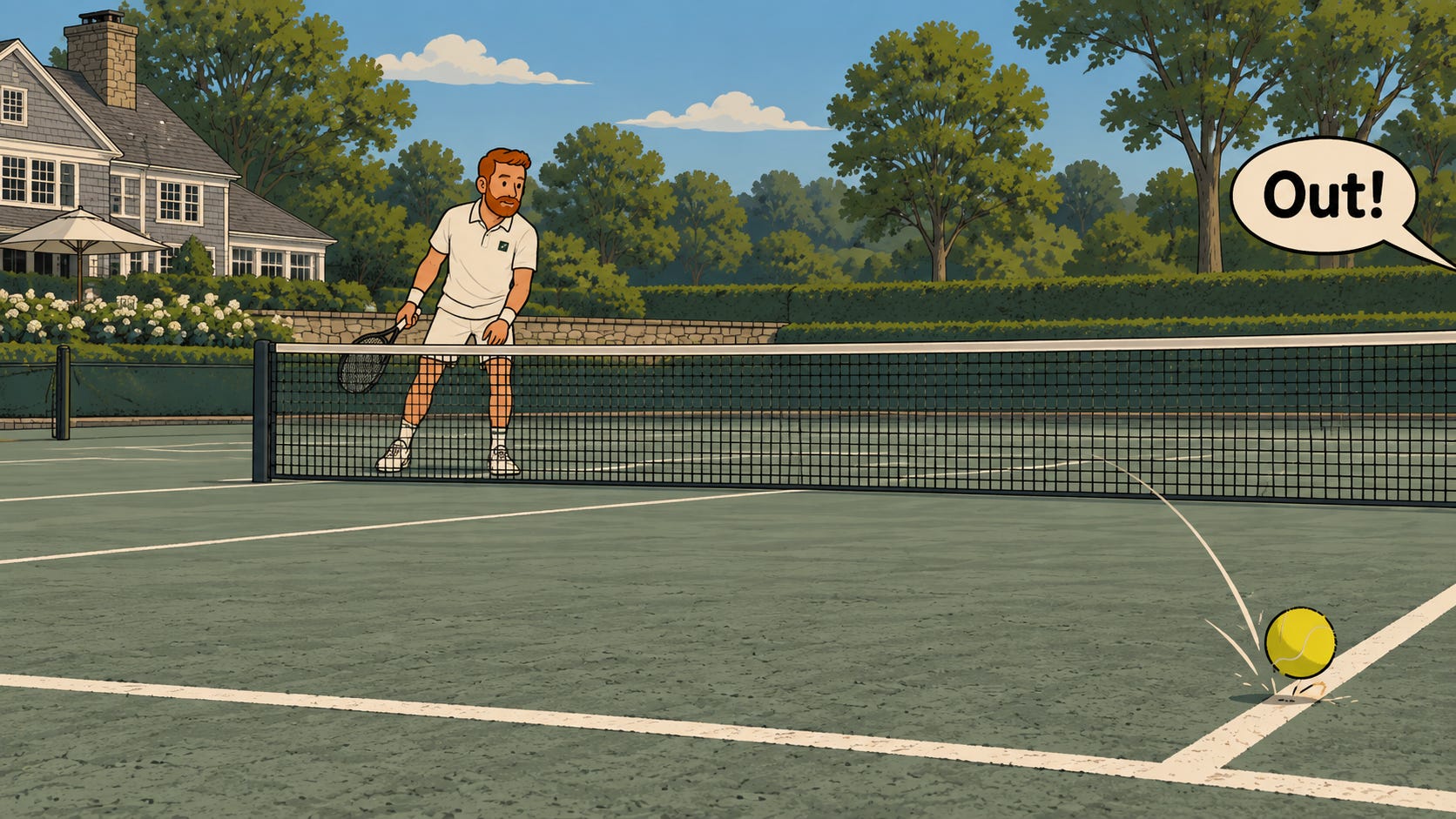
Spirituality and belief are BIG questions. I’m not going to dive into them here.
The closest I’ll get is a strong belief that “Ball don’t lie.” There is karmic justice on the court, and it’s often delivered swiftly.
Used in pick-up games everywhere, the fuzzy etymology of this phrase traces back to street ball in Philadelphia. It’s been the title of novels and podcasts, but the most famous usage came in 2012 when Rasheed Wallace shouted the phrase and promptly earned himself a second technical foul and ejection from the game.
This was far from the first time he said it - teammates estimated he’d dropped it hundreds of times over the prior years - but it was directly antagonizing, and the official’s patience had been worn thin after years of being taunted for miscalls.
The NBA is a little bit different than a pickup game, where the referee in theory has an objective duty to both teams. If you’re just messing around with your buddies, foul calls are your responsibility, and that’s difficult. We need a third opinion.
Say what you will about middled aged eye sight, but it’s really hard to make close calls in racquet sports. (Obviously we’re also ripping the ball.) There’s no Hawk Eye technology sponsored by Chase, it’s up to you to make that call for or against yourself, all while being caught up in the heat of the point.
Ball don’t lie happens a lot. We’re pretty generous with each other outside league games, so the first call usually stands and everyone moves on. Thus after a shadowy out of bounds call, you’ll inevitably fault the serve.
By putting the weight of adjudication in this fuzzy little rubber bit, we concede to a higher power. Not a deity that judges you for being right or wrong, but a greater sense of fairness. It absolves the player from the risk, gravity, and shame of making a bad call, and acts as a counterweight to the imperfections of man.
For the purposes of decorum, it’s generally accepted that the committer of the original sin gets to recognize the ball’s resetting of the scales of justice. When the benefactor of karma starts taunting, that deserves a technical, and is hardly befitting of a game played in all whites.
The only other abstract being I have the same confidence in is the market. Market don’t lie. Sure there are kinks in the curve, and orderflow that temporarily dislocates quotations from fair value, but the arc is decidedly towards truth. And increasingly swiftly.
At face value, it’s an important truth. The market is the best estimate of trillions of dollars of capital. Every opportunity should be framed in the context of proving that the current prices are incorrect. The only way you generate alpha is by consistently showing the market is mispricing something.
Armchair macro traders can sit in their group chats pontificating about how overvalued the AI trade is or how rates won’t go below 2% for another five years. (I sold that put in the chat this morning.) Opinions are what make money, but it’s an extremely high bar to cross. You might get lucky with one opinion, but ball don’t lie, justice is likely coming back on your next big idea.
How we interact with the market also invites a certain degree of karma. From the market making perspective, there are numerous different styles of how to quote and trade. There are low frequency, large order opportunities to capture, and there are active turnover electronic styles of pricing.
The options market maker must price the cost of liquidity, and that truth is inevitable. Whether it’s upstairs or on the screens, there is a temptation to “carp” markets, or provide just a slightly higher bid or lower offer. Stepping ahead of the collective opinion ensures you will get the first fill, but it’s also a challenge to the consensus pricing.
Just as a buy side trader can generate alpha by proving the market incorrect, dealers can be profitable by challenging the cost of uncertainty. They’re incentivized to - that’s how they win orderflow and directly provide a benefit to the customer. But if they are too aggressive about it, too greedy about carping their competitors, the true value of liquidity will eventually show itself.
Winning a large order upstairs marks well on the daily PnL sheet. Markets may only shift slightly, preserving a fat pile of edge. But as time passes, the cost of managing that will add up, and if there’s a need to trade out of or around the position, it’s unlikely the liquidity will be as good as it once was. Markets don’t lie.
For athletes one of the theories for why the ball doesn’t lie is that humans have an aversion to inequity. A study of NBA foul calls found that after an obviously erroneous foul call, the first free throw percentage dropped from an average of 79% to 55%. Interestingly, the second free throw reverted almost exactly to the mean, and this phenomenon was only significant when the foul shooter was on the winning team.
There are conflicting motives here - while the winner can be subconsciously gracious and prey to inequity aversion, the loser’s competitive drive overshadows that. The ball might not lie, but I also want to win.
Traders are playing their own Inner Game of Tennis. One of the hardest parts about a big win is staying focused and not giving it away or getting too confident about your next trade. And if deep down you know you got lucky, it takes a sociopath to not have some degree of inequity aversion.
Whether there’s some celestial force that ensures pickup games everywhere come as close to their true outcome as possible, is far above my paygrade. It certainly seems like it sometimes. Regardless, the belief in that force has its own benefits, such that it almost doesn’t matter who’s pulling the strings.
With markets it’s easier to point to why karmic justice is delivered so swiftly. There’s capital and competitive incentives to get to the truth as quickly as possible. But the internal forces are as important as the external ones.
If you believe that market don’t lie, you instantly calibrate expectations about how successful a trade can be, recognizing the burden of proof. And on both winners and losers, it gives you the serenity to accept the result. A belief in process over outcomes for losers, and the gracious awareness that all winners come to roost.