
The Liquid Experience
Vol #281: July 23, 2026

Liquidity is my favorite subject.
Options liquidity, stock liquidity… liquid liquidity.
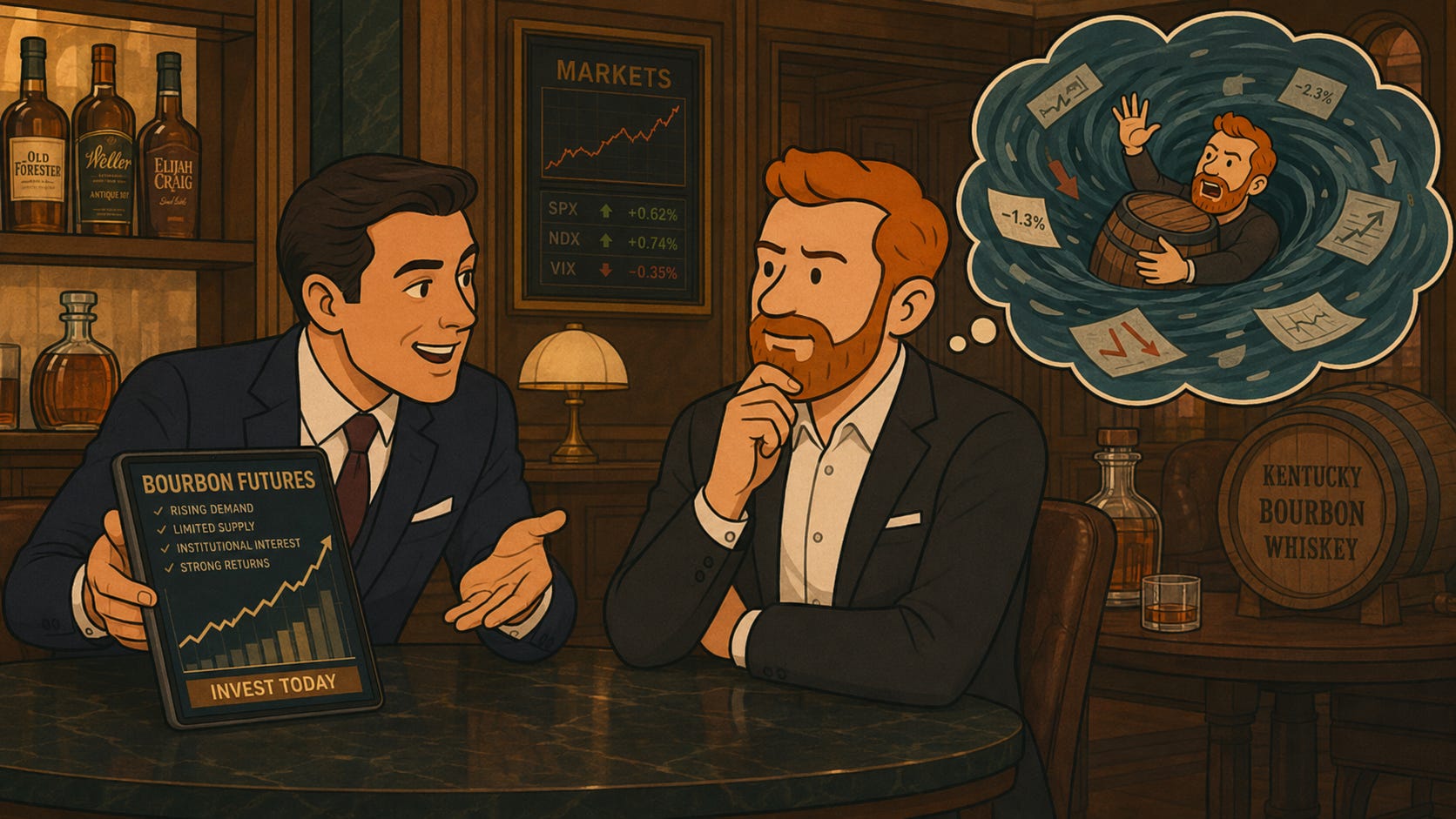
I find it cropping up in the places I least expect. Like the clickbait ads that are so ridiculously precisely targeted, I can’t help but fork over my personal information for more details about bourbon futures.
Buy brand new whiskey, let it sit for a couple of years, and voila you’re earning 14-18% CAGR. I’m no stranger to liquid alternatives, and this one is missing the burn.
Storage fees were taken care of, and there was even a portfolio manager who could recommend a ladder of different ryes and wheated bourbons. As the angel’s share left the barrels, offers would start pouring in.
Trying not to let the subject matter distract me, I wanted to poke holes in this. Pricing was twenty cents on the dollar compared to what I saw on retail shelves. I know there are a lot of mouths to feed in the distribution chain, but doubling your money in four years still leaves plenty of fat for wholesalers and liquor stores.
The liquid in the barrel comes from some esteemed producers, so pedigree isn’t the concern. The liquidity to be concerned about here is where the buyers come from and at what price.
There is absolutely a secondary market for bourbon. Outfits like MGP offer an outsourced distilling solution, and a selection of pre-aged spirits for impatient whiskey entrepreneurs. No need to wait four years, you can build a custom blend today. Buy it from this guy who clicked on an Instagram ad.
So why aren’t they or anyone else involved buying these spirits up at pennies on the dollar? Structural edges like that are usually the reward of active participants. If the return is such a lock, why aren’t there distillers, banks, or funds that are scooping this up? In commodity markets the difference between delivery now and later is the cost of carry. That’s not free money.
If the carry is already baked in, some other factor is massively discounting the grand inevitably of life and markets - the passage of time. A product that gets better with age, and you’re being offered it at four to five times the risk free rate. What kind of hidden risk makes packaging this up in a 506(b) offering the best source of capital?
The heartstrings pull strong here. If I took just one of the barrels and bottled it myself I’d have Christmas gifts for 20 years. There’s a very significant cool factor. Supporting an industry, and being able to fancifully claim your small but important role in the f-eye-nahn-sing of American whisky makes for great cocktail party chatter.
But that’s all the more reason to be suspicious from the get-go. The fantasy of being a bourbon baron fuzzes the arithmetic faster than what’s in your glass. Even if they use financial words like returns, ladders, and diversification, this is just a bet that someone wants to buy your booze.
It’s hard enough to look at the most liquid markets in the world and guess what the experience of the future return path looks like, but at least I know I can sell or buy when I need to. How the hell do I have any confidence about moving 25 barrels of old corn juice?
The numbers only matter when it’s your turn to get out. Liquidity is a metric that we can analyze through bid ask spreads and market depth. We can talk about activity, turnover, and open interest as other symptoms of fair and durable pricing.
But liquidity is also an experience. Every trade is different. When you interact with the market you change the landscape and risk will never look the same again. Dramatic emphasis mine, but trade execution is far from a predictable controlled physics experiment.
Over time if you make enough trades the winners and the losers start to balance out. A good fill here nets against a bad one later on, and some meaningful conclusions can be drawn about the average cost to transact and price impact.
The ultimate price you pay or receive on a transaction is unknowable until the fill hits. Most retail orders aren’t going to choke a market maker’s position sizing, so while that’s more intuitive than impactful, it could absolutely happen around the margin.
What’s far more likely is something benign like a senior trader being on summer vacation and the trainee covering is brand new so he turned off their dark pool responses. Or she was out for a delta walk buying a $10,000 burrito.
Little bumps in the road like that might leave a ding, but they’re an afterthought in most of the liquid stocks and options. The real risk is that no one is there at all.
The worst thing about bad liquidity is that it usually looks like good liquidity when you dip your toes in. C’mon in, the waters warm, we’re all beating the S&P with no downside risk.
If the liquidity is bad when you’re putting on the trade, you at least know what you’re up for. If I’m hunting down bourbon barrels, knocking on distillery doors, it starts to make sense why there might be some premium. That’s a return on effort.
The problem with fancy sounding investments is not a lack of optimism. Which is all the more reason to double click until you find the catch. The opportunities all look rock solid and boundless until something completely unknowable happens.
Even as I talk myself out of this, there’s still a little bit of me that’s intrigued. The sizzle is really selling this hard. Maybe there is an untapped bourbon financing market. A curiosity I’ll ponder from afar with a rocks glass in hand.
I’ll have to pass and settle for what could have been. Not only do I not see the clear path out of the trade, someone bought my eyeballs to get into it. If bourbon comes with a headache, I at least want a taste.
Man, you are a great writer! I always enjoy reading these. Breathless was great too. Thanks for sharing, Mark!