

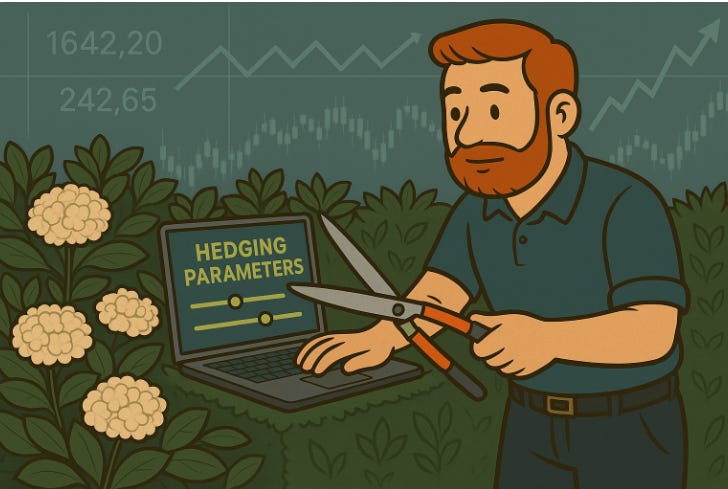
There are many kinds of hedges.
Yesterday we talked about how market makers or portfolio managers think about balancing their exposure to underlying movements. A hedge will give up something, but it delivers consistency, which allows for scale and leverage.
That hedge row in your garden protects you from the neighbors. It might even flower during the summer. But come wintertime, or early spring, it’s time to do some pruning.
There’s a debate with hydrangeas about whether you should trim the dead flowers in the fall or in the spring. After reading the pros and cons of trimming now, and realizing some of the cons are “but I like the way they look”, I understood that it doesn’t really matter. It’s a personal preference.
There is a certain amount of preference when it comes down to financial hedging also. There is a pure alpha answer of what the best returns and sharpe looks like. There is room for preferences too, as we don’t all have the same tolerance as to what keeps us up at night. Or tolerance for FOMO on the flip side when you were only 70% long during a roaring bull market.
Hedging introduces complexity beyond just the decision process. A perfect offset isn’t really a hedge, because outside of arbitrage you don’t have much of an exposure. So as we get more nuanced, it’s extremely important to understand why that works, and when it might not.
I’m currently beta testing the automation of a strategy that I have long worked with as a portfolio overlay. The newly nicknamed “SkewPreme” uses synthetic options deltas to replace underlying stock deltas. Earlier this year we talked about this with “The Best 30 Deltas You Can Buy.” The point of that was that it does improve results, but is a lot of work. Hence the automation.
The target here is enhanced returns at the same volatility as the S&P 500. The options provide a tailwind thanks to the way skew is priced, but they move fast. A fundamental part of the risk management is containing these gamma exploding deltas.
But just how much should you trim? If you hedge too much, you squander the edge. If you don’t hedge enough then bad becomes worse. We want those perennials and portfolios blooming again and again.
Today in the Backtest Notebooks, we’ll do a deep dive into different hedging parameters for the SkewPreme strategy. We’ll review the data for different delta tolerances, and align that with theory on why the strategy is able to contain downside.
Keep reading with a 7-day free trial
Subscribe to The Till to keep reading this post and get 7 days of free access to the full post archives.