
Complexity is a canard
Vol #254: December 11th, 2025

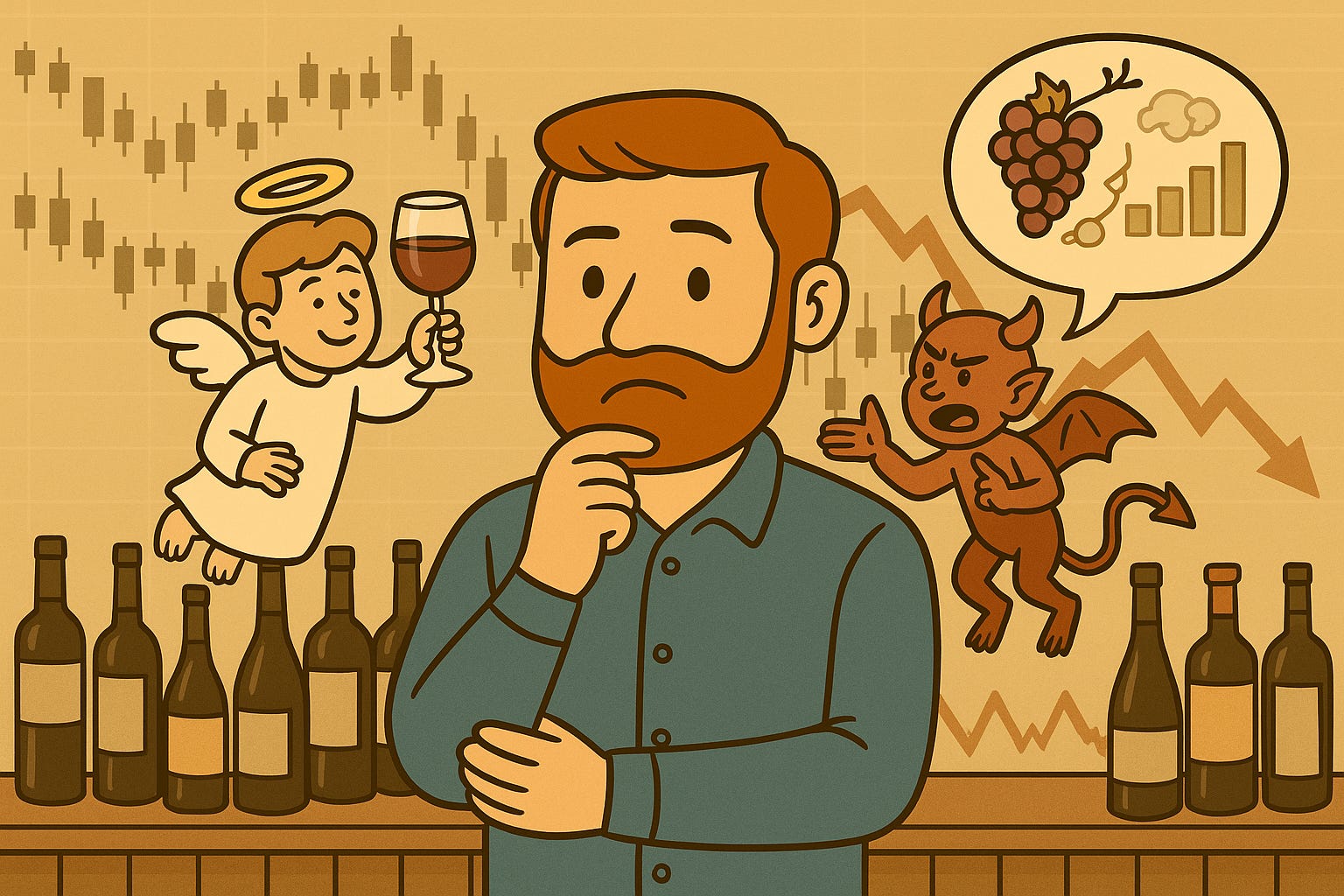
A particularly acute way to indicate snobbery is to use a domain precise term when discussing a topic of expertise.
Now don’t get me wrong, I’m a huge fan of the proper terminology. Talk nerdy to me.
But perhaps some of the friction comes from the tightened nasal passages that are required to draw out the long “a” when you pronounce the word cépages to refer to the grape in your glass. You’re not wrong, you’re just a braggart. It mostly doesn’t matter.
To the credit of those who do use this absolutely more correct term - you are my friends - the casual translation of the word as varietal doesn’t quite get it. And even the use of the English word varietal is going to raise an eyebrow from the Kim Crawford crowd.
Briefly, an important nuance of the word cépages is that it implies multitudes. A varietal connotes defined boundaries that say this is Cabernet Franc. Cépage has the same holistic nature as terroir which appreciates the organic reality of plants that evolve and inherit their place.
The wine grape is mostly reproduced through plant cuttings, maintaining a high level of consistency compared to what would result from natural sexual reproduction. There are tens of thousands of clones that have been documented, but every grape represents the potential for a slightly new plant.
However there is still some selection and adaptation that naturally happens in the vineyard. Choices are made about vines with different resistances to drought or harvest time. Not all Pinot Noir is quite the same plant material, and the definitional contours of cépage reflect that not only are there distinctions within a bucket, but also that those lines are evolving.
Now all of that is true, I think it’s very interesting, and provides meaning in conversations over that specific level of detail. But it provides no insight into what is the truly fundamental question.
Does it taste good?
Talk all about how the cépages evolve in their foudres, what’s most important is: do you like the result? The point of drinking wine is to enjoy it, and the point of trading is to make money. Options traders love to talk about all kinds of fancy risks that are modeled with tricks cribbed from physics. But it all comes down to the dollars and cents.
The greeks are a risk structure particularly unique to options positions. The famous ones - delta, theta, vega - represent the option prices’ sensitivity to input changes. I have a call or put worth X, given all the other assumptions I made to get here, if stock price moves Y, how much does that option’s value change? That’s delta.
Theta does the same thing with the passage of time. If nothing else changes - how much is my option worth tomorrow. Vega is the sensitivity to volatility moves, which is why professional traders will most commonly focus on this risk. A market maker understands that directional risk is kept minimal, but what they’re really long and short is volatility.
These are important definitions to understand if you want to trade options. Unlike stocks that just go up and down, we have many dimensions of movement that can impact a position’s price. It would be hard to talk about wine if you’re unfamiliar with the difference between Cabernet Sauvignon and Sauvignon Blanc.
Unsatisfied with simple first order exposures, traders will compound their analysis by looking at how changes in one affect the other. Gamma is the most popular second order consideration, which describes how a position’s delta will change if stock moves. High gamma happens at spot, at expiration, when a single stock tick will drop a position in or out of the money. Gamma goes away when stocks move very far from the strike price.
There are other model features we can describe with greeks like vanna or charm. How much does delta change when implied volatility shifts or time passes. If an FOMC announcement or earnings call takes the inflated premiums out of your position, it’s obvious how different your directional exposure has become.
What I start to hear though, is that long “a” of cepages echoing in the word vanna. Most of the time that’s used in a sentence, I’m going to think you’re a blowhard trying to show off.
It’s not that I don’t think vanna is real, I just think unless you’re in the back room making the wine, you should understand this concept as an intellectual tourist rather than as a practitioner. The vast majority of edges that buy side traders can capture are significantly simpler than that.
Just because the greeks exist to describe it, doesn’t mean you should get wrapped up in unhelpful degrees of precision. The most important thing to focus on when you make an options trade is how much did you pay (collect) for it and how much can you lose. In American Dollars.
The first place to look is your straddle. This is your hammer. The dollars and cents here not only encapsulate all the second and third order distributions that someone else has worried about, but it’s conveniently framed in a way that works with your PnL.
Speaking of PnL, unless you are a liquidity provider, your positions should always be framed in dollar terms. Yes market makers will think of their vega risk limits, but they’re playing a different game. Every options trade is an allocation of a percentage of your NAV, that should have a very defined risk and reward.
For investment positions that we use to manage long term holdings, my goal is to strip out all of the complexity and explain expected returns not with muted deltas and kurtosis capture, but in the expected difference in dollars and returns. “This has X% more balance swings but Y% better returns.”
And for all the PhD level math that the most sophisticated of practitioners are doing, they’re thinking in dollar terms too.
All the derivatives in the world don’t help you when a stock gaps. There’s no dynamic hedging and it’s up to the animal spirits to decide where things are newly priced. So the simplest way to think about your exposure is to create a matrix of moves, and simulate how much the position makes or loses and any given combination. It won’t be perfect, but it creates a very informative heat map.
Managing intraday or overnight position risk is also helpful to boil down to simple dollar terms. Delta is pretty intuitive, and basically means “shares long”, but shares of TSLA are different than TLT. If you want to have a standardized hedging program - bring it all back to dollars.
Because risk means losing money (dollars) we convert this theoretical sensitivity into something that’s meaningful. Vol$Deltas (implied vol * stock price * delta exposure) are widely used as a threshold because it respects that not only do more volatile stocks have bigger ranges, but that move is different in a $500 and $5 stock.
One catch to the rule of always thinking is dollars is the temptation of “dollar cheap” options. Risk managers love to point out options on the board with leading 0s that could really tame a position. That absolutely makes sense if you’ve got an edge engine and you’re looking to pay a little to get rid of a worst case.
And while I’m all for a fun little YOLO play to throw a few bucks at your casual conviction, the pricing on these is really difficult. Systematically buying things that look dollar cheap requires significant discipline and a strong filter for opportunity. Unless you’ve already made something and are looking to lock it in - caveat emptor.
Complexity is a canard. It’s mentally stimulating, but alone isn’t a way to make money. You don’t get bonus points for doing it fancy. Results - in the glass or in the account - are what really matter.
I will happily purchase tomes on plot composition and bore my readers with details about vegetative reproduction, but I will never buy a wine based on my knowledge of cépages. Just like I will never make an options trade based on vanna, and don’t think you should either.