
Privilege isn't recognized here
Vol #282: July 30th, 2026

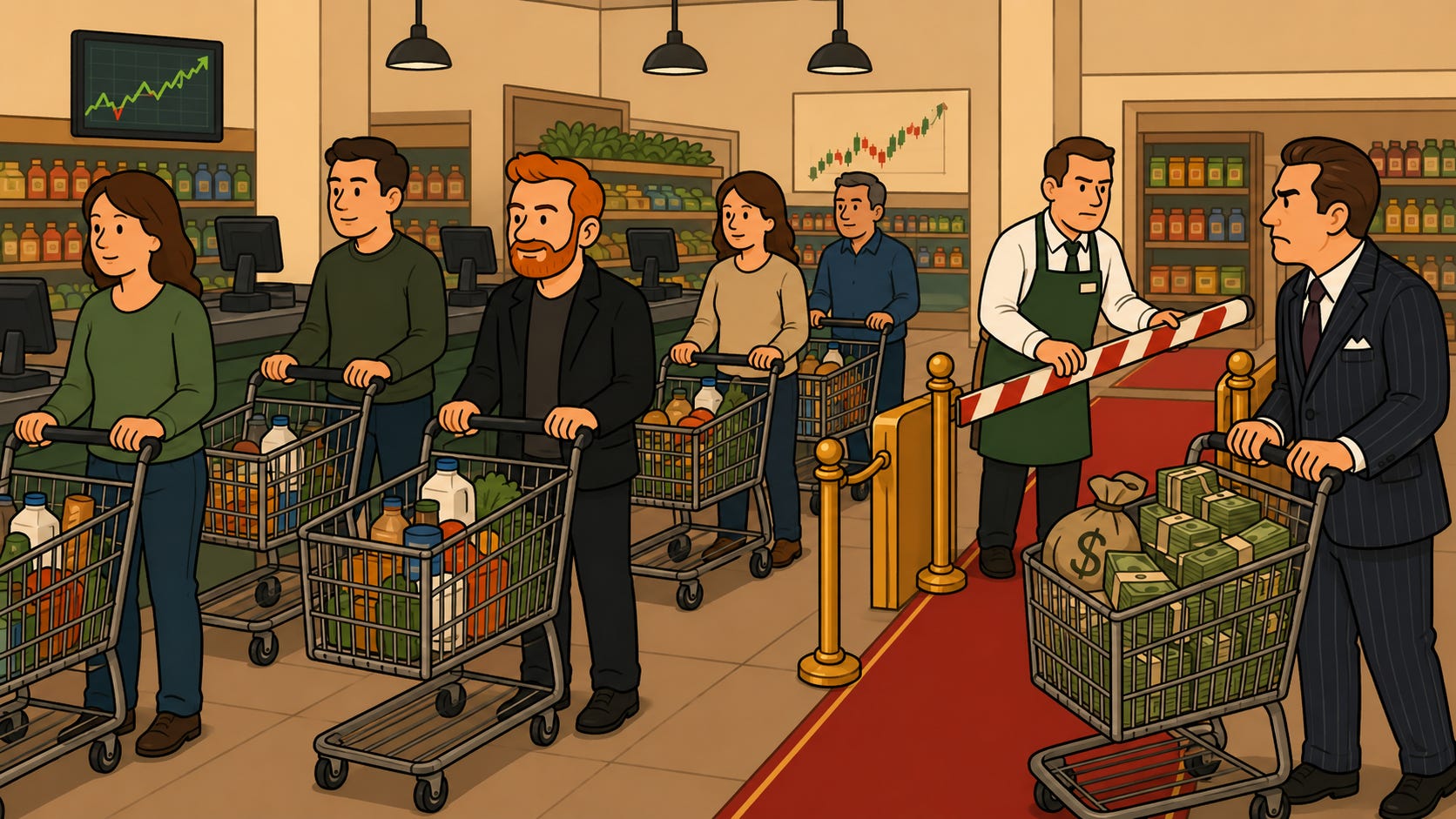
You are not special. You are not a beautiful or unique snowflake.
You’re the same order as everyone else.
Human beings have an innate sense of fairness. We chafe at the vehicles cutting an obvious line at Exit 31. Game theory experiments with the ultimatum game shows that players will refuse to accept an opponent’s proposed split of the pot if it is unfair - leaving both empty handed.
Whether observers or participants, we like a good sporting fight.
Our justice instinct isn’t based on some rational calculation. Even in versions of the ultimatum game where the recipients cannot reject the offer, the proposer will still offer some (meager) allocation to his counter party.
Yes we understand that life and society are mostly a series of repeated games, and that reputations are prized and retaliations will come due. But there is something deeper than calculus here, where a sense of societal norms must be maintained and exploitative behavior must be punished.
A red card might carry over to the next game, but that’s a rare exception in competitive interactions. Whether it’s sports, markets, or markets on sports - most rules are structured to make sure things are fair in every single interaction.
There’s less to grumble about when the rules are clearly posted and everyone is bound by the same obligations, responsibilities, and queue position. You might not like waiting in the slow line at the grocery store, but it’s hardly “unfair.”
But here’s where another part of human nature seeps in. 73% of Americans think they’re above average drivers. I’m in an important hurry - just this once. Can you please make an exception here?
Simple presents invaluable clarity in the face of complex and dynamic forces. Eroding that with asterixis, carve-outs, and regulatory pork maligns the integrity of competition.
The bedrock of markets is fairness. Price discovery and the resulting efficiency of capital allocation can only be achieved through mechanisms that cleanly promote equilibrium.
Seeing the proposal from the SEC to eliminate the provisions of Rule 611 regarding trade through protections rankles everything I believe about order handling and market structure. Top of book should be respected by everyone, not ignored because you have a fancy compliance department who can justify it ex-post.
When the “National Market System” was formalized via the implementation of Reg-NMS in 2007, the idea was simple - if there’s a market center with a better price, that had to be traded first. Exchanges became protected venues, where brokers had an obligation to trade the cheaper offer or higher bid before executing at a better price.
There are various self interested reasons why a broker might not want to trade there. Perhaps there’s the benefit of hitting a fee tier by doing a certain amount of volume. Or more sinisterly they know the counterparty at a different venue. Maybe it’s just a pain to manage such complexity.
This provided an order by order imperative that the customer was going to get the best price. No wishy washy promises of best efforts and lutte raisonnée, this was a nearly pure black and white line.
But now less than twenty years later, apparently the leaps and bounds of technological advance have obviated the need for customer protections. And the lobbyists have convinced the Commission that the burden of connecting to different venues is too much for a well compensated industry. And woe be them, the compliance is such a headache.
I’m rather unsympathetic to those arguments, because if you want to be a broker, that’s your job. That’s what the money’s for.
Are there venues that are part of the NMS system with extremely low volume and present a moderate headache - absolutely. But that can easily be solved with a better definition of who’s part of the system (e.g. a market share minimum resolved every quarter). Far better than throwing out the entire rule.
Larger orders are always brandished as something that deserves special treatment. They’re not looking for volume discounts on transaction costs (those are already baked in), but rather a privileged lane to execute in, immune from their own market impact and pesky reverberations of a market digesting new information.
Block orders come from many sources. Sometimes it’s a hedge fund or large active participant trying to lock in an edge. But just as often the end customers of that block order are the thousands of retail holders of a mutual fund or ETF. When an asset manager wants to rebalance, they represent thousands of tiny mom and pop orders, who are the ultimate beneficiaries of better pricing.
The best argument for open outcry trading and the source of resilience of manually negotiated orderflow is that outsized liquidity is better handled mano y mano. Markets might overreact to 100 x 10 lots coming in, and while a single 1000 lot will move the market, there will be less turbulence if the whole size is digested at once.
What the prosecutors of Rule 611 ignore, is that there are already specific exceptions that allow large/block orders to execute more cleanly while also maintaining the purity of the rule. Intermarket Sweep Orders (ISOs) are the primary mechanism that allow large orders to trade immediately, and they are a straight forward way to deterministically get size and price. There might be room to strengthen this by looking at depth and timing considerations, but throwing out the full kit is not the answer.
What I find particularly ironic about the proposal to remove trade through protections is that while the current burden is poorly quantified, the cost of implementation is significant, and the impact of an altered market structure will be borne by the least sophisticated participants.
Trade through protections have been a fundamental pillar of order routing for almost two decades. Broker and exchange software has been built around this assumption. The algorithms that drive better executions for every class of participants will need to have their assumptions completely rewritten.
Does everyone remember the demonized High Freak Traders? When Reg-NMS was implemented, there was a several year period where sophisticated firms were making a killing taking advantage of the new microstructure. Faster connections between venues and order type gaming skimmed billions of dollars into a few pockets before the rest of the market caught up.
Market fragmentation is a difficult problem. Dark pools are eating the lit venues’ lunch, and that has its own structural risks. Without good lit markets to lean on, dark risks becoming less efficient. And tiny venues with niche customer bases create an outsized impact on the smooth functioning of a larger exchange.
But a better price is a better price. And large orders need to pay for the cost of their impact.
We already have a principles based review of best execution responsibilities. There exist allowances for trade throughs in appropriately limited scenarios. Removing the structural line and codifying exceptionalism opens a wide lane for abuse.
There’s a Pandora’s box of excuses and exceptions for why this order is different. I’m skeptical about how removing the basic concept of “no cutting in line” does anything to support better price discovery or customer protection.
If you’re even 10% as passionate as me about market structure, there’s still an opportunity to comment on this. You can submit one here, and view the other responses, which have been overwhelmingly against the removal of Rule 611.