
Sniping the establishment
Vol # 264 - March 5th, 2026

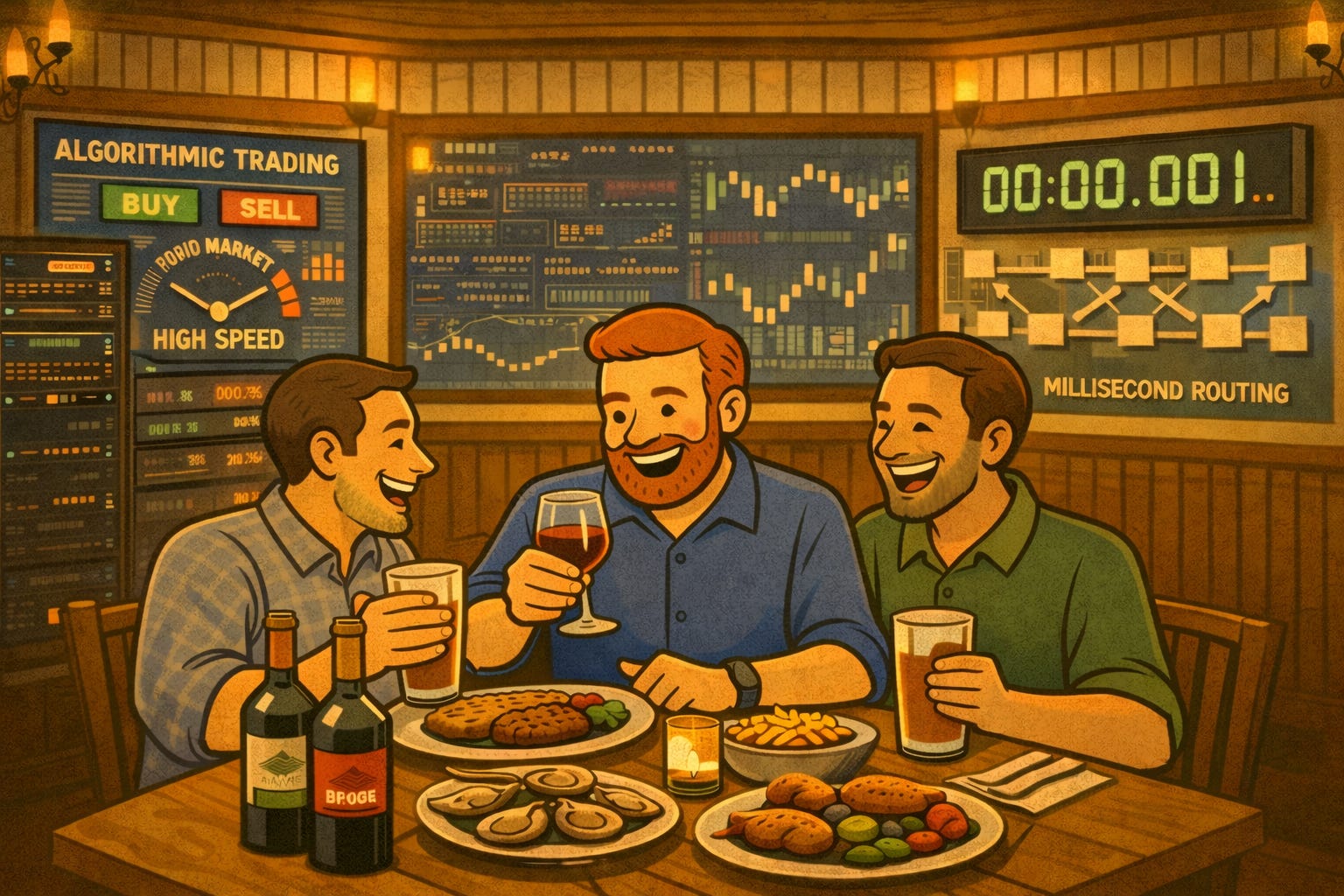
There are restaurants, and there are establishments.
In Paris we spent countless Sundays at the Brasserie Lorraine. Multi generational, quality seafood, and a warmth that grew exponentially over time. Nothing like a seasoned French garçon to rib you about the pronunciation of Rully and Reuilley. Et comme toujours - le sole meunière pour la petite?1
This week I had dinner with friends in the city, and the obvious choice was another brasserie. Blue Ribbon isn’t the kind of place that earns Michelin stars, but the quality and atmosphere speak for themselves. Innovation here is a few barrel aged cocktails, consistency is how the fried chicken repeatedly delivers. Good food, easy atmosphere, a lot to catch up on.
I’m mostly thankful for what Resy and OpenTable have done for diners. It’s really easy to scan a menu of choices, and push a simple button. Calling into a restaurant isn’t exactly difficult, but there’s enough millennial in me to avoid an unnecessary conversation when I can.
Fortunately/unfortunately, there are dozens, probably hundreds of truly great establishments in New York City. The haut couture set clamors for a spot at Chef’s Table, but the stalwarts of Minetta Tavern and Locanda Verde are never shy of diners. Click click book.
Put anything interesting and seductive on the internet - and there’s algorithmic competition. While I’ve heard of services that will call the Thomas Keller hotline for you, programmatically booking up all the hot spots is pretty easy to automate. And it’s ruined it for the rest of us.
If you want to get a prime table in Manhattan, you’re logging in at 6am, exactly thirty days in advance. Fighting off the scalpers to claim a simple spot to buy dinner, the competition is heated. We’ve reached a point where for anything the New York Times is writing about, your only hope is the secondary market or a table in temporal Siberia.
eBay ran into the same problem. Auction out your unused closet and make a couple of bucks on the side. Just like a cottage Etsy business, this was a way to liberate the individual thanks to the grace of broadband. Then came the snipers.
For a nominal fee, your true final price could be bid seconds before the auction closed. No time for the competition to escalate, the scoop was precisely timed. Eventually these order types integrated into the platform itself, and a fundamental component of any auction is the theta decay. It wouldn’t be an option or an auction without an expiry date.
When you set up rules, they are bound to be gamed. The bright white line says whether the ball is in or out, and the shot clock is visible to everyone. Bids are due by 10:31 PST, may the highest win.
Ask any real estate agent and they’ll have order types even an algo salesman couldn’t imagine. Escalation clauses and what-ifs provide conditionality for every contextuality. Auction settlement rules for the milliseconds after everyone has submitted their best.
Markets however rely on determinism. For the auctions that route the vast majority of retail orderflow, there is a final set of parameters due by the start time. Initiators have the opportunity to match or improve, and the customers are guaranteed to get the best price. But it all has to happen within a 100 millisecond window. Here the establishment is the players who are focused on this narrow game.
Just because there are bright lines and cutoffs doesn’t mean there isn’t some gamesmanship. Savvy routers will send orders most likely to get broken up to the venue with the highest rebate. Other flow that is particularly desirable is sent to exchanges with low market share and less competition.
Fragmentation creates an opportunity but also a hurdle to manage. Each venue is its own distinct set of rules, and view on the world. In open outcry it mattered who got heard first, with electronic order routing every ping has a white light fiber race.
The New York Stock Exchange houses its databases in Mahwah, New Jersey. The Chicago Board Options Exchange in Secaucus. Miami International Holdings is across the parking lot, while Nasdaq is a few towns over in Carteret. While these data centers exist in a golden triangle of colocation, since the internet is only a series of tubes, how fast anything gets from one place to the other is a matter of basic physics.
Exchanges have tried many things to combat this structural problem. Whether its a physical or technical obstruction, some explicit modifications are required. Like a circular race track that staggers the 100M starting distance, BATs tried coiling cables to make sure everyone had the same timeline to the finish, IEX has fought to introduce long enough delays that any advantage from speed is gone while orders wait to execute with an enforced delay and updated market data.
For slight mispricings that only an HFT can appreciate, these methods are effective. True pickoff flow that exploits the slightly slower participant isn’t necessarily conducive to liquidity. Yes it’s a harsh world of bids and offers, but pure speed games only reward the fastest, and it takes two to make a market. Constructive price discovery is about digesting information and orderflow, not taking advantage.
Timing is just as important for the tortoise as it is the hare. Even when offers float lazily unchanged as the ticks go by, when the time of your choosing comes, it’s important to be precise about how you grab the prize. While the customer just hits a buy button, the other side is tracking every single interaction on that strike and reacting in due time.
Market makers are compelled to put out liquidity on multiple different strikes to optimize their capture. It’s relatively unpredictable whether a customer will go to BATS or MIAX or NYSE, but the dealer knows if 10 trade there, they want a piece.
The over liquification of many strikes creates a misleading but binding promise. Every order is tradeable if hit - the bedrock principle of firm quote - but not every order really wants to trade if it knew all the other very recent context.
So for the savvy taker, to get all of the size that is shown on the screen, you need to time the pounces. An exchange that sits 10 milliseconds further away from you needs to be sent 10 milliseconds earlier. These distances change as technology improves or the tilt of the earth adjusts.
This is a fairly unique use case. Most retail orders aren’t even hitting the screens, and size institutional orders are generally trying to be as quiet as possible - no smash and grab, lift all the offers. Further, if you think you’re going to out fox the participants who’s business model relies on being as nimble and reactive as possible, you’re playing the wrong game.
Solid buy side trading strategies shouldn’t rely on timing. Whether its high or low frequency timing, be suspicious of a claimed edge in picking spots. Long term investment strategies should seek to mitigate timing risk, not enhance it.
It sounds sexy to be a sniper, taking advantage of wit, skill, and precision. It’s academically interesting to understand these deep layers of market structure, but it’s never going to be the retail traders game.
If you really want to snipe the establishment, flip timing on its head. Never be forced to put on or take off a position. Don’t trade just for the sake of it, make sure you have an intentional edge or risk transfer objective. Slow play your execution - looking too skittish and snipe-y is going to scare off any liquidity provider.
Absolute precision is an ephemeral edge. The landscape is always shifting, and it’s the dealers job to stay on top of that evolution. The most durable strategy for a buy side trader is looking towards options not to pick off the establishment, but to align those trades with their own long term objectives.
When a meal comes to a close, you’re doing a disservice trying to rush the establishment. Nobody wants to wait for their check, but there are a lot smarter ways to ask than a big hand wave and a call for the “garcon!” Sniping before or after a meal ruins a restaurant experience and the buy side of trading in the same ways - just enjoy the company.
“As per usual, the sol meunière for the little girl?”